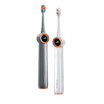
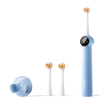


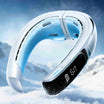
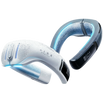




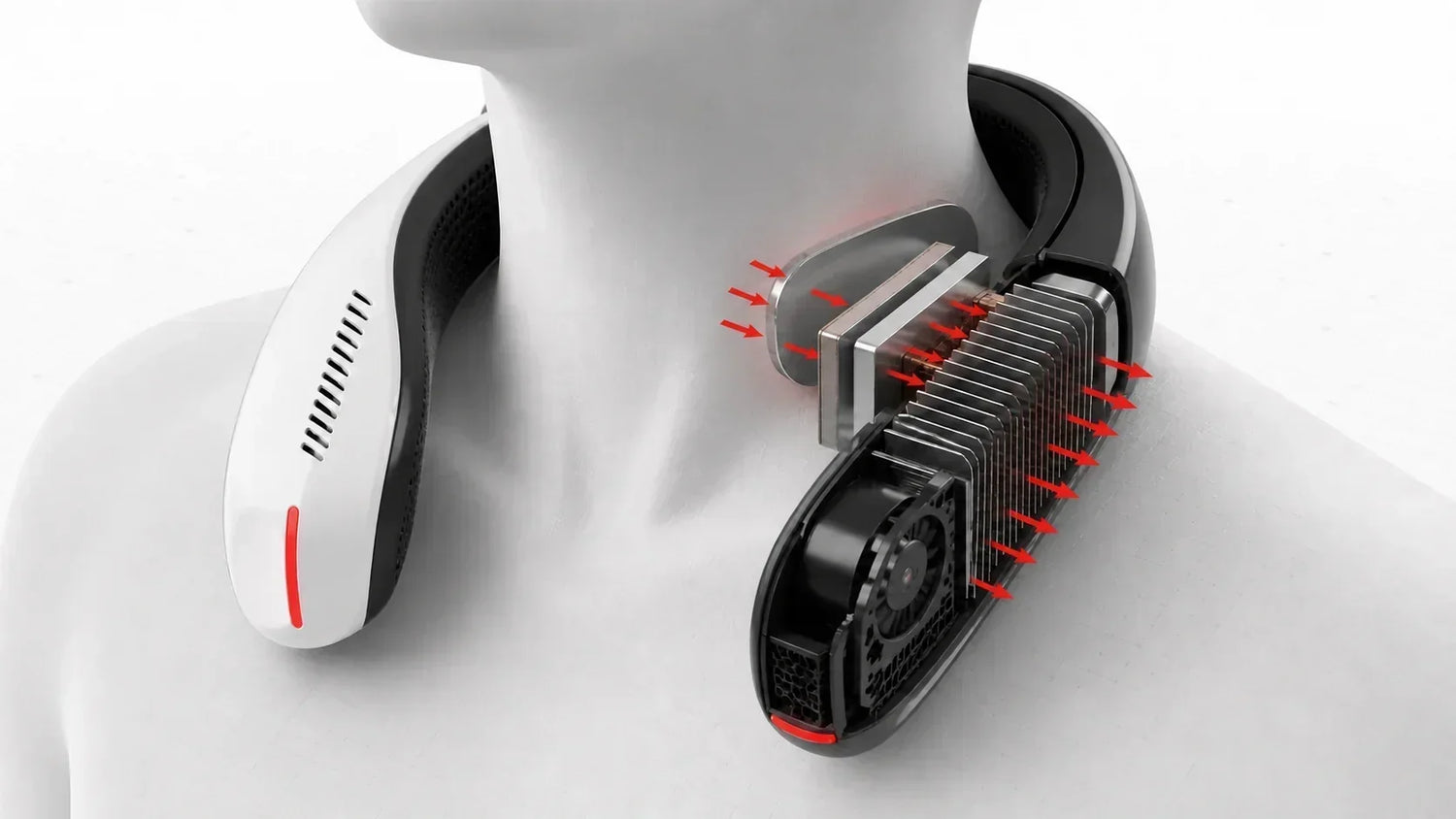
The short answer: A Peltier cooler uses DC power to move heat from a skin-facing plate to a hot-side heat sink, creating local contact cooling rather than cooling the whole room.
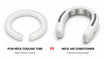
The cold plate in a wearable air conditioner can feel surprisingly different from the airflow of a conventional neck fan. That sensation is usually created by a thermoelectric cooler, also called a TEC cooler, Peltier module or Peltier cell cooler. It has no compressor and no circulating refrigerant. Instead, it uses electric current to pump heat through a compact solid-state module.
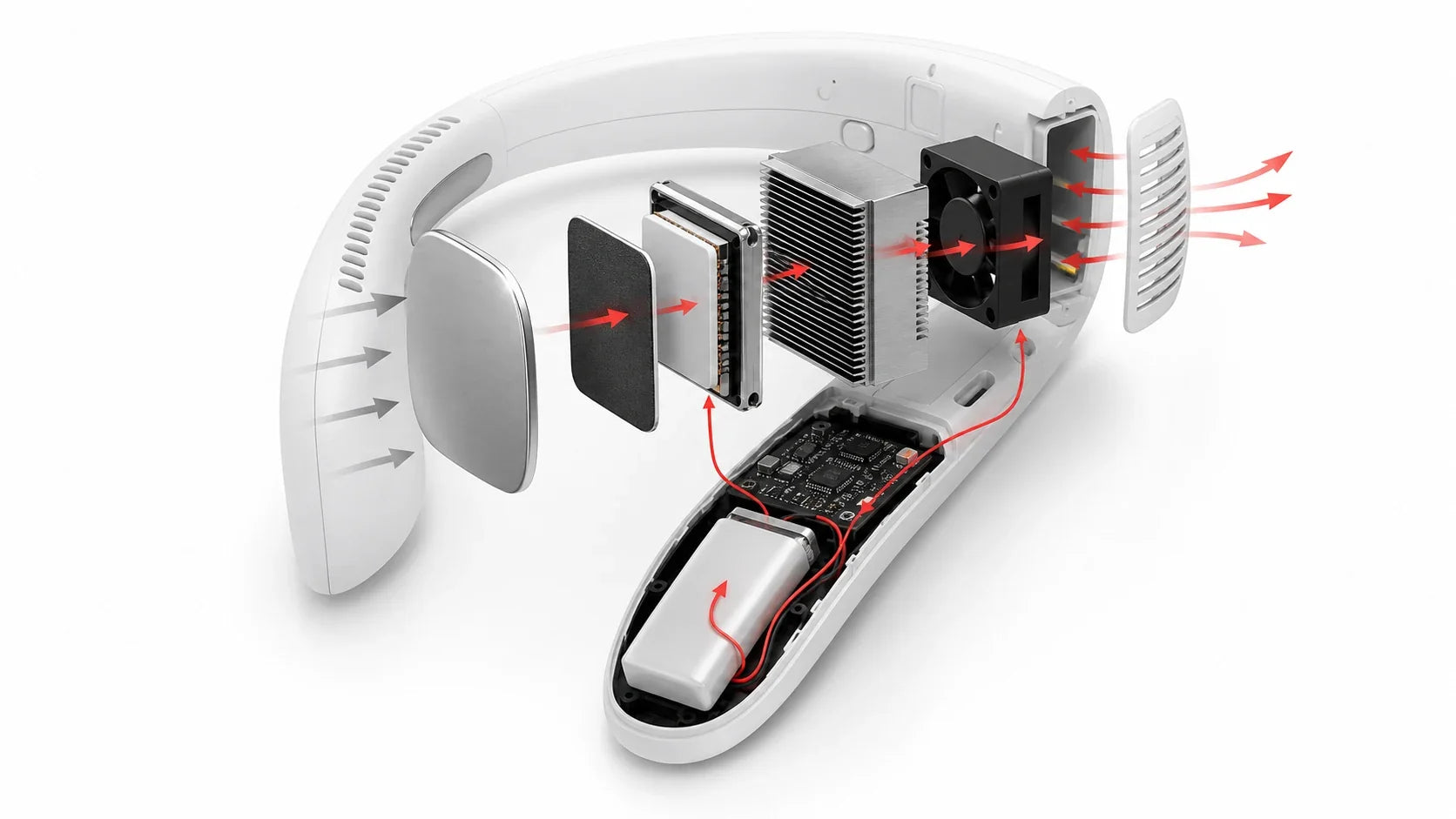
The module is only one part of the system. Every watt of heat absorbed at the cold side must travel through the device and leave from the hot side. The electrical power used by the module also becomes heat that must be rejected. A wearable product therefore needs a cold plate, thermal interfaces, a hot-side heat spreader or heat sink, airflow, temperature sensing, control electronics and a battery that can support the selected mode.
Understanding that complete heat path makes it easier to interpret temperature claims, compare products and recognize why contact, ambient conditions and fan design change the result.
What is a Peltier cooler?
A Peltier cooler is a small solid-state heat pump. When direct current passes through the module, one face absorbs heat and the opposite face releases it. Reversing the current reverses the heat-flow direction, which is why the same thermoelectric module can be used for either cooling or heating in a properly controlled system.[1][2]
A typical module contains many pairs of p-type and n-type semiconductor elements between ceramic plates. The elements are commonly arranged electrically in series and thermally in parallel. Current passes through the semiconductor couples, while heat is transported from the cold side toward the hot side.[2][6]
You may see several names for the same basic component:
-
Peltier cooler emphasizes the physical effect;
-
thermoelectric cooler or TEC cooler is common in engineering documentation;
-
Peltier cell cooler refers to the module or cell;
-
cooling Peltier module is common in product and component searches; and
-
thermoelectric cooling module is a descriptive technical term.
These names do not tell you the finished product’s performance. A bare module can create a temperature difference on a laboratory bench, but a wearable air conditioner must work while heat is entering from skin, warm air surrounds the device and a small battery powers both the TEC and its fans.
For a broader comparison of thermoelectric devices, fan-only products, cooling vests and other formats, start with our guide to the wearable air conditioner category.
How does the Peltier effect create a cold side?
The useful explanation does not require treating the module as if it “makes cold.” It moves thermal energy.
When DC current flows through the p-type and n-type semiconductor couples, charge carriers transport heat across the module. At one set of junctions, the module absorbs heat; at the opposite set, it releases heat. Change the current direction and the hot and cold faces switch.[1][2]
Three effects act at the same time:
-
Peltier heat pumping moves heat in the desired direction. This is the effect the product uses to cool the contact plate.
-
Electrical resistance creates Joule heat. More current can increase heat pumping, but it also increases resistive heating inside the module.
-
Heat conducts back from the hotter side toward the colder side. As the temperature difference grows, this unwanted backflow becomes more important.
This explains a common performance curve: increasing current can improve cooling up to a useful operating region, but more current is not automatically better. Higher current also adds electrical heat and increases the burden on the hot-side heat sink. The best control point depends on the thermal load, hot-side temperature, desired cold-side temperature and available power.[3][4]
Peltier cooling is active heat transfer
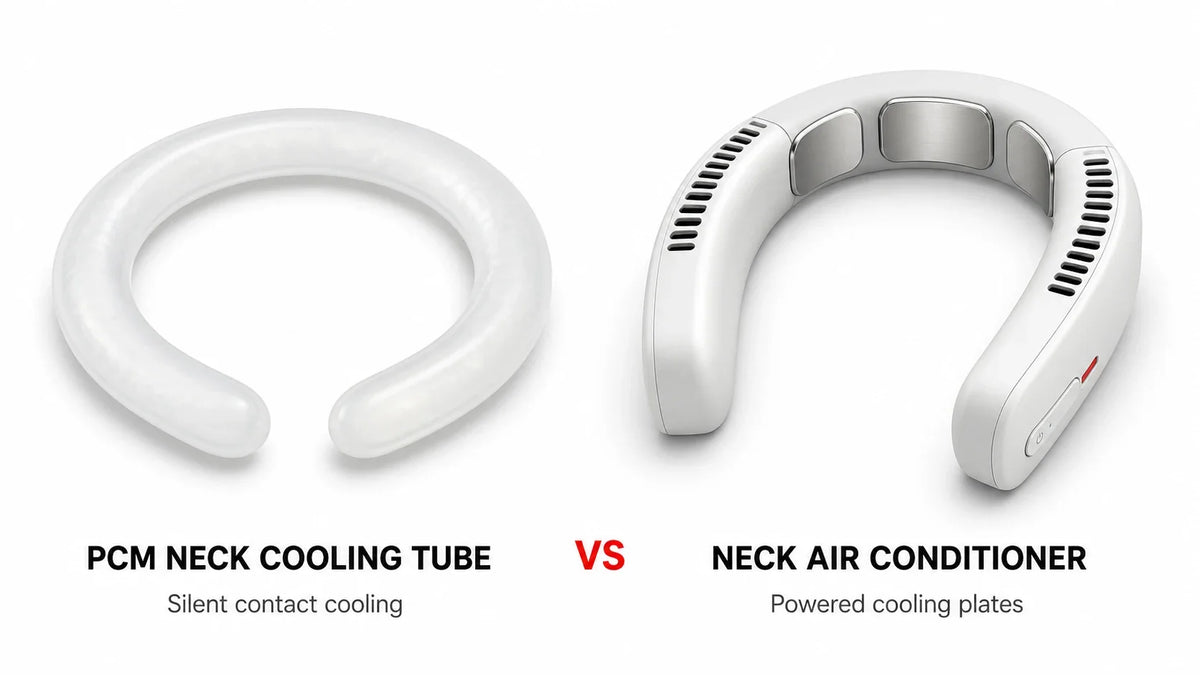
A fan-only neck device moves ambient air. It may improve comfort by supporting sweat evaporation and replacing warm air near the skin, but it does not refrigerate the airflow. A Peltier air conditioner adds active heat transfer at the contact plate, allowing that surface to operate below the temperature it would reach through airflow alone.
The result is local. If a cold plate touches the back or sides of the neck, it primarily affects the skin under and immediately around that plate. The sensation can be distinct even when the cooled area is small. That is different from lowering room temperature, and it is not automatically evidence of a change in core body temperature.
Cold side, hot side and heat sink: the complete heat path
The simplest useful diagram is:
Skin → contact plate → thermal interface → TEC cold side → TEC hot side → heat spreader → heat sink → moving air
Each step can limit the final result.

1. The contact plate collects heat from the skin
The visible plate is usually a thermally conductive surface connected to the module’s cold side. It spreads cooling over an area that may be larger than the TEC itself and protects the module from direct mechanical contact.
Good contact matters. A plate that only touches at one edge has more thermal resistance than a plate that sits evenly against the intended area. Neck shape, device opening, hinge geometry, spring force, hair, collars and movement can all change the contact area. Stronger pressure may improve heat transfer, but too much pressure creates discomfort. Wearable design is therefore a balance between thermal contact and long-term fit.
2. The TEC pumps heat across the module
The cold side absorbs heat at a rate commonly represented as Qc. The achievable value is not fixed. It changes with input current, hot-side temperature, cold-side temperature and the temperature difference across the module.[4]
Two advertised specifications are easy to misuse:
-
Maximum temperature difference (
ΔTmax) is generally associated with little or no useful heat load on the cold side. -
Maximum heat-pumping capacity (
Qmax) is specified near a zero temperature difference between the module faces.
Those two maxima do not occur at the same operating point. A bare cooling Peltier module reaching a low no-load plate temperature does not prove that a wearable product will maintain the same temperature while pressed against warm skin.
3. The hot side receives more heat than the cold side absorbed
The system must reject both the heat pumped from the cold side and the electrical input power:
Qh = Qc + Pin
Here, Qh is heat leaving the hot side, Qc is heat absorbed at the cold side and Pin is the electrical power supplied to the TEC. Ferrotec’s thermoelectric model uses this same energy balance.[4]

For example, if a system absorbed 2 watts at the cold plate while the module consumed 4 watts, the hot side would need to reject approximately 6 watts, before separately accounting for heat from fans, power electronics and other nearby components. This is an explanatory example, not a claim about any RANVOO model.
4. The heat sink releases heat to the environment
The heat sink is not an accessory. It is part of the cooling system. If it cannot release heat quickly enough, its temperature rises. That increases the temperature difference the TEC must work across, reduces useful heat pumping and can warm nearby product surfaces.[3]
Compact wearable products usually use forced convection: a fan or blower moves air across fins or another high-area structure. Fin geometry, surface area, airflow rate, intake clearance and exhaust direction all matter. Blocking an intake with hair or a collar can therefore affect more than airflow comfort—it can reduce the thermoelectric system’s ability to move heat away from the cold plate.
The warm exhaust does not mean the cooling plate is fake. It is evidence that heat is leaving the system. The engineering question is whether the device keeps hot-side heat separated from the skin-facing cold path and discharges it without causing an uncomfortable hotspot.
How a Peltier cooler works inside a wearable air conditioner
A practical thermoelectric air conditioner worn around the neck is a coordinated system rather than a module wired directly to a battery.
| System component | What it does | What can go wrong |
|---|---|---|
| Skin-facing plate | Collects local heat and spreads cooling across the contact area | Incomplete contact, excessive pressure, sweat buildup or uncomfortable edges |
| Thermal interface material | Reduces microscopic air gaps between solid surfaces | Poor coverage, aging, uneven compression or excessive thickness |
| TEC module | Pumps heat from cold side to hot side | Incorrect operating point, excess current, thermal stress or moisture ingress |
| Hot-side spreader and heat sink | Moves and distributes rejected heat | Insufficient area, poor flatness, high thermal resistance or heat recirculation |
| Fan or blower | Carries hot-side heat into ambient air | Blocked intake, weak airflow, irritating noise or exhaust returning toward the neck |
| Temperature sensors | Monitor plate or heat-sink conditions | Slow response, poor placement or controls that rely on only one temperature |
| Controller | Regulates current and coordinates modes | Overshoot, unstable control or a high mode that adds power without useful cooling |
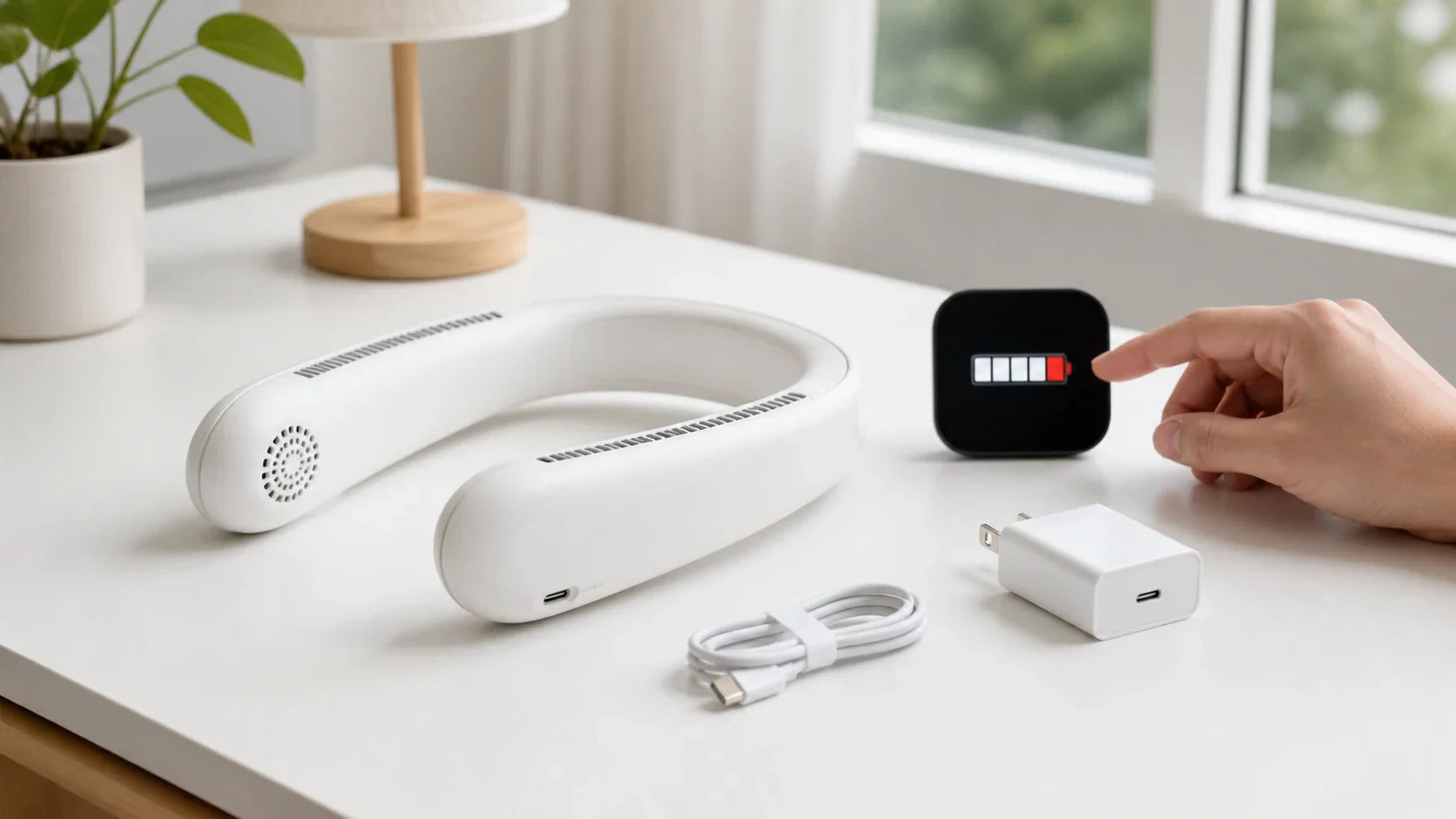
| Battery and power electronics | Supply and convert electrical energy | Voltage sag, conversion loss, battery heating or short maximum-mode runtime |
| Housing and fit system | Holds thermal parts against the body while separating hot and cold paths | Uneven load, neck pressure, poor ventilation or heat conducted through the frame |
Startup, steady state and movement
At startup, the cold plate may fall in temperature quickly because the plate and module have not yet absorbed much heat from the wearer. Once the device contacts skin, the thermal load increases. The hot-side assembly also warms until heat input and heat rejection move toward balance.
This is why a single temperature photographed seconds after startup is incomplete evidence. A more useful test reports the time curve, ambient conditions, whether the plate was under a representative load and whether the device remained stable after several minutes.
Movement changes the system again. Walking may increase external airflow around the heat sink, but hair, clothing or body position may intermittently block an intake. Fit may also shift the cold plate away from the skin. A product that looks strong on a flat bench can feel inconsistent if its mechanical design cannot maintain contact on a moving wearer.

Cooling capacity, power and battery tradeoffs
Thermoelectric cooling is attractive because it is compact, solid state, controllable and free of a circulating refrigerant loop. Its main wearable constraint is the relationship between heat moved, electrical power and hot-side heat rejection.
Heat pumping is not the same as electrical input
Cooling capacity is the rate of heat removed from the cold side, Qc. Electrical input is Pin. Their ratio is the cooling coefficient of performance:
COP = Qc / Pin
A COP of 0.5 would mean that the module pumps 0.5 watt of cold-side heat for each watt of electrical input at that operating point. COP changes with current, temperature difference and hot-side conditions; it is not one universal number for all Peltier modules or products.[4][5]
For consumers, this leads to a simple rule: battery capacity alone cannot predict cooling performance. Two devices with the same watt-hour rating may use different modules, control strategies, fan power, cold-plate areas and maximum-mode limits.
Why maximum mode can have diminishing returns
Raising TEC current can increase heat pumping, but it also increases Joule heating and total hot-side load. If the heat sink is already near its practical limit, added input can mainly make the hot side warmer rather than delivering an equal improvement at the skin.
A well-designed controller may therefore use staged modes, temperature feedback or power limits. The strongest short burst is not necessarily the most efficient or comfortable setting for a long commute. Compare time-stamped plate temperature, power and runtime on the same mode instead of comparing the coldest advertised number from one product with the low-mode runtime of another.
Why ambient temperature matters
The hot-side heat sink ultimately releases heat into surrounding air. In hotter air, the heat sink starts from a higher baseline and has less temperature margin before product surfaces become uncomfortable or controls reduce power. Still air, restricted intakes and heat recirculation can make this worse.
Humidity affects comfort and moisture management. A cold surface operating below the local dew point can collect condensation.[7] On a wearable device, sweat is an additional moisture source. The module, seals, sensors, metal surfaces and cleaning instructions must therefore be designed around real contact use—not only dry laboratory operation.
Why a Peltier wearable cannot cool an entire room
A room air conditioner removes heat from indoor air and rejects it outdoors through a refrigeration system. A neck-worn Peltier device absorbs a small amount of heat at a local skin-contact area and releases that heat—plus its electrical input—back into the same surrounding room.
From the room’s perspective, the wearable is a net heat source while it is operating indoors:
Heat released to room = local heat moved from skin + electrical energy consumed
The wearer may feel cooler because heat is being moved away from a sensitive contact area and because the device may also direct air around the neck and face. The room does not become cooler. This is the distinction between personal thermal comfort and space conditioning.
The same boundary applies to body cooling. Local skin cooling can be meaningful without proving whole-body heat removal or heat-illness protection. Peer-reviewed wearable thermoelectric research has demonstrated localized skin-surface cooling under controlled designs, while also identifying the thermal resistance of skin and ambient air—and hot-side heat dissipation—as central challenges.[6][8]
Treat a wearable Peltier cooler as a personal comfort device unless a specific broader outcome has been measured under conditions that match the intended use. It should not replace hydration, shade, acclimatization, work-rest controls or medical and occupational heat-safety guidance.
How to evaluate Peltier cooling claims
The strongest evidence connects plate temperature to ambient conditions, contact load, power and time.
Look for these measurements
-
Ambient temperature and relative humidity: A temperature result without test conditions is difficult to compare.
-
Cold-plate temperature over time: Prefer a curve from startup through stable operation over one lowest reading.
-
Hot-side or exhaust temperature: This shows whether the heat-rejection system is keeping pace.
-
Representative contact load: A no-load plate and a plate drawing heat from a skin simulator or wearer are different tests.
-
Power by operating mode: Record voltage, current and total system watts—not TEC input alone if fans and electronics use the same battery.
-
Runtime by mode: Maximum cooling, balanced mode and fan-only operation should be reported separately.
-
Contact area and fit: State plate dimensions, where the plates touch and whether contact remains stable during movement.
-
Noise and surface comfort: Thermal performance is not useful if fan noise, weight or hot surfaces make the device impractical.

Be cautious with these claims
-
“Drops 20 degrees instantly” without defining Fahrenheit or Celsius, the starting temperature, test surface, elapsed time and ambient conditions;
-
a bare-module
ΔTmaxpresented as the expected drop on human skin; -
a coldest plate temperature paired with runtime measured in a lower-power mode;
-
“semiconductor refrigeration” used to imply room-scale air conditioning; and
-
thermal-camera images without consistent emissivity, reflected-temperature settings, distance and surface preparation.
An infrared camera is useful for showing heat distribution, but shiny metal plates can produce misleading readings. A contact sensor attached correctly to the test surface should be used to validate critical temperature values.
A reproducible test plan for wearable Peltier cooling
The following protocol turns the article’s explanation into evidence that can be audited.
Original evidence required before publication: Replace this callout with RANVOO test results after engineering review. Do not publish numerical cooling, power or runtime claims until the conditions and instruments below are documented.
Test setup
-
stabilize the room or chamber and record ambient temperature, relative humidity and air speed;
-
fully charge the device and document battery state, firmware and operating mode;
-
record ready-to-use mass and cold-plate contact dimensions;
-
measure total input voltage and current at a defined sampling interval;
-
attach calibrated contact sensors to each cold plate and the hot-side heat spreader;
-
use a repeatable heated skin simulator or controlled fixture for comparative load testing; and
-
document fan intake and exhaust clearance.
Test sequence
-
Record baseline temperatures with the device off.
-
Run a no-load startup test to show how quickly the plate changes without skin heat entering it.
-
Repeat under a controlled thermal load and report cold plate, hot side, ambient and electrical power on the same timeline.
-
Test each marketed mode separately until temperatures stabilize or the mode automatically changes.
-
Repeat the key test with one realistic partial obstruction to show the effect of compromised airflow, but stop before exceeding the product’s operating limits.
-
Conduct a fit trial using an approved human-subject or product-comfort protocol, reporting contact stability, pressure, noise and perceived comfort separately from instrumented thermal performance.
-
Repeat trials and report variation rather than presenting only the best run.
Frequently asked questions
Can a Peltier cooler go below ambient temperature?
Yes. A correctly powered TEC with adequate hot-side heat rejection can make its cold face cooler than ambient. The useful temperature under load depends on the module, current, contact heat, hot-side temperature and thermal resistance throughout the assembly.[1][3][4]
Why does the hot side need a fan?
The hot side must reject the heat pumped from the cold plate plus the TEC’s electrical input. In most compact air-cooled applications, forced airflow lowers the heat sink’s thermal resistance and helps prevent hot-side temperature from rising enough to reduce cooling performance.[3]
Can reversing the current switch cooling and heating?
Yes. Reversing DC polarity reverses the direction of heat pumping. A finished wearable product should only do this when its hardware, sensors, firmware and safety limits are designed for bidirectional operation; users should not reverse product wiring themselves.[1][2]
Is a Peltier cooler the same as a compressor?
No. A Peltier cooler is a solid-state thermoelectric heat pump with no refrigerant circuit or compressor. It is compact and easy to control, but its heat-pumping efficiency and heat-sink requirements differ from vapor-compression cooling.[1][2]
Does a larger Peltier module always cool better?
No. Module size is only one variable. The device must supply the required current, spread heat evenly, maintain cold-side contact and reject the larger hot-side load. A poorly matched large module can overwhelm a compact heat sink and battery.
Why does the plate feel less cold after a few minutes?
The startup plate may initially have little thermal load. After contact, heat enters from the skin while the hot-side assembly warms. Controls may also reduce power to manage temperature, comfort or battery demand. A time curve is needed to distinguish normal settling from inadequate heat rejection.
Can moisture damage a thermoelectric cooler?
Moisture can be a design concern when a cold surface drops below the dew point, and wearable products also encounter sweat. Module sealing, drainage, corrosion resistance and cleaning instructions should be reviewed as part of the finished system.[7]
The bottom line
A Peltier cooler does not create cold from nothing. It uses electricity to move heat from a skin-facing plate to a hot-side heat sink. The module can be compact and responsive, but the wearable product succeeds only when contact, airflow, thermal interfaces, sensors, controls and battery capacity work together.
When comparing wearable air conditioners, do not stop at the lowest advertised plate temperature. Ask what the device cooled, under what load, for how long, at what ambient temperature and power level, and how the hot side released the heat. Those answers reveal more about real performance than a bare-module maximum or a brief no-load demonstration.
Sources
[8] Hong et al. (2019), “Wearable thermoelectrics for personalized thermoregulation,” Science Advances.