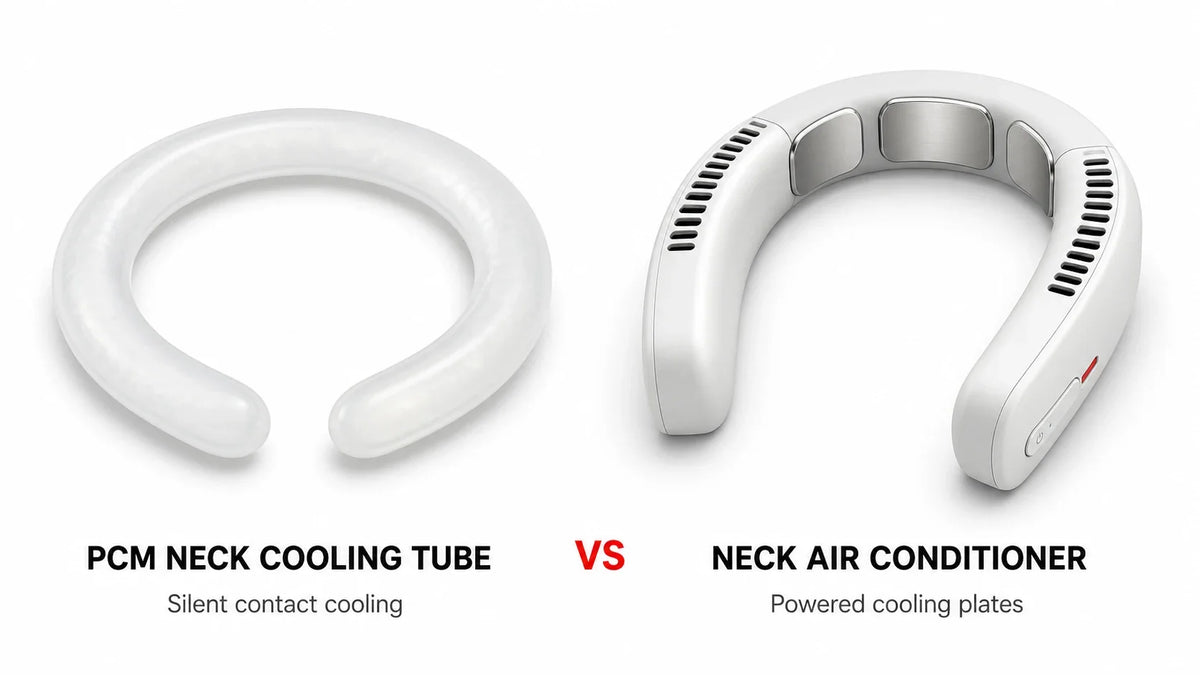
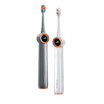
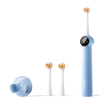




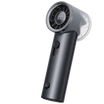
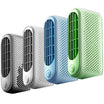




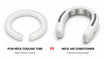


The short answer: A neck fan moves ambient air, while a neck air conditioner adds powered cooling plates that create a colder contact point on your skin.
The two products often look similar. Their listings can sound similar too.
That makes shopping confusing.
A basic neck fan uses airflow. A neck air conditioner usually combines airflow with thermoelectric cooling plates. Those plates touch the neck and move heat away from a small area of skin.
The active-cooling model can feel colder. It also tends to use more power and weigh more.
Neither type cools an entire room. Neither should replace a heat-safety plan.
This guide compares them on equal terms. It covers cooling feel, battery life, weight, noise, price and care.
The difference in one table
Start with the mechanism. Most other differences follow from it.

| Feature | Neck fan | Neck air conditioner |
|---|---|---|
| Main cooling method | Moves surrounding air across the neck and face | Uses airflow plus one or more thermoelectric contact plates |
| Does it refrigerate the airflow? | Usually no | Usually no; the plates create the cold surface |
| Immediate sensation | Breeze | Breeze plus a cold contact point |
| Works without sweat? | Airflow is still noticeable, but evaporation adds much of the cooling benefit | Plates can feel cool without sweat |
| Humidity sensitivity | Higher because humid air slows evaporation | Contact cooling is less dependent on evaporation, but the full device still depends on fit and heat rejection |
| Power demand | Usually lower | Usually higher when active cooling is on |
| Typical weight | Usually lighter | Usually heavier because of modules, heat sinks and larger power needs |
| Runtime priority | Often better for long fan use | Often shorter on maximum active-cooling mode |
| Main noise source | Fans near the ears | Airflow fans plus hot-side cooling fans |
| Best starting use | Long commutes, desk use and users who mainly want airflow | Humid weather, strong cold sensation and users who value contact cooling |
These are category-level patterns. They are not guarantees for every model.
A well-designed fan can outperform a poorly fitted active-cooling device for one user. A heavier neck air conditioner can also be worth it when cold plates are the main reason for buying.
How a neck fan works
A neck fan pulls in surrounding air. Small blowers then direct that air toward the neck, jaw or face.
The device does not normally make the air colder. It changes how the skin exchanges heat with the environment.

Air movement supports comfort
Still air forms a warm, humid layer near the skin. Moving air breaks up that layer.
The breeze can improve convection when the air is cooler than the skin. It can also help sweat evaporate.
Evaporation matters. As sweat changes from liquid to vapor, it carries heat away from the skin.
This is why a neck fan may feel stronger during a warm walk than in a cool, dry room. It is also why humidity can change the result.
A controlled study tested wearable face and neck fans at 30°C and 32°C. Relative humidity was kept at 50 ± 5%. The devices improved local and overall thermal sensation under those conditions.[1]
The result supports a real comfort benefit. It does not mean every design performs the same way.
Fit controls where the air goes
Airflow is useful only when it reaches the wearer.
Hair can cover outlets. A collar can redirect the stream. A blocked intake can reduce flow and raise motor noise.
Check vent placement before buying. Also check whether the arms can be adjusted.
If you want a full explanation of open-head, enclosed-air-channel and active-cooling designs, start with our neck fan guide.
“Bladeless” does not always mean blade-free
A bladeless neck fan usually has no exposed propeller near the face. Internal impellers still move the air.
The enclosed design can help keep hair away from the moving parts. It can also spread airflow through several outlets.
The word bladeless describes the user-facing design. It does not describe a new cooling mechanism.
How a neck air conditioner works
A neck air conditioner adds active heat transfer.
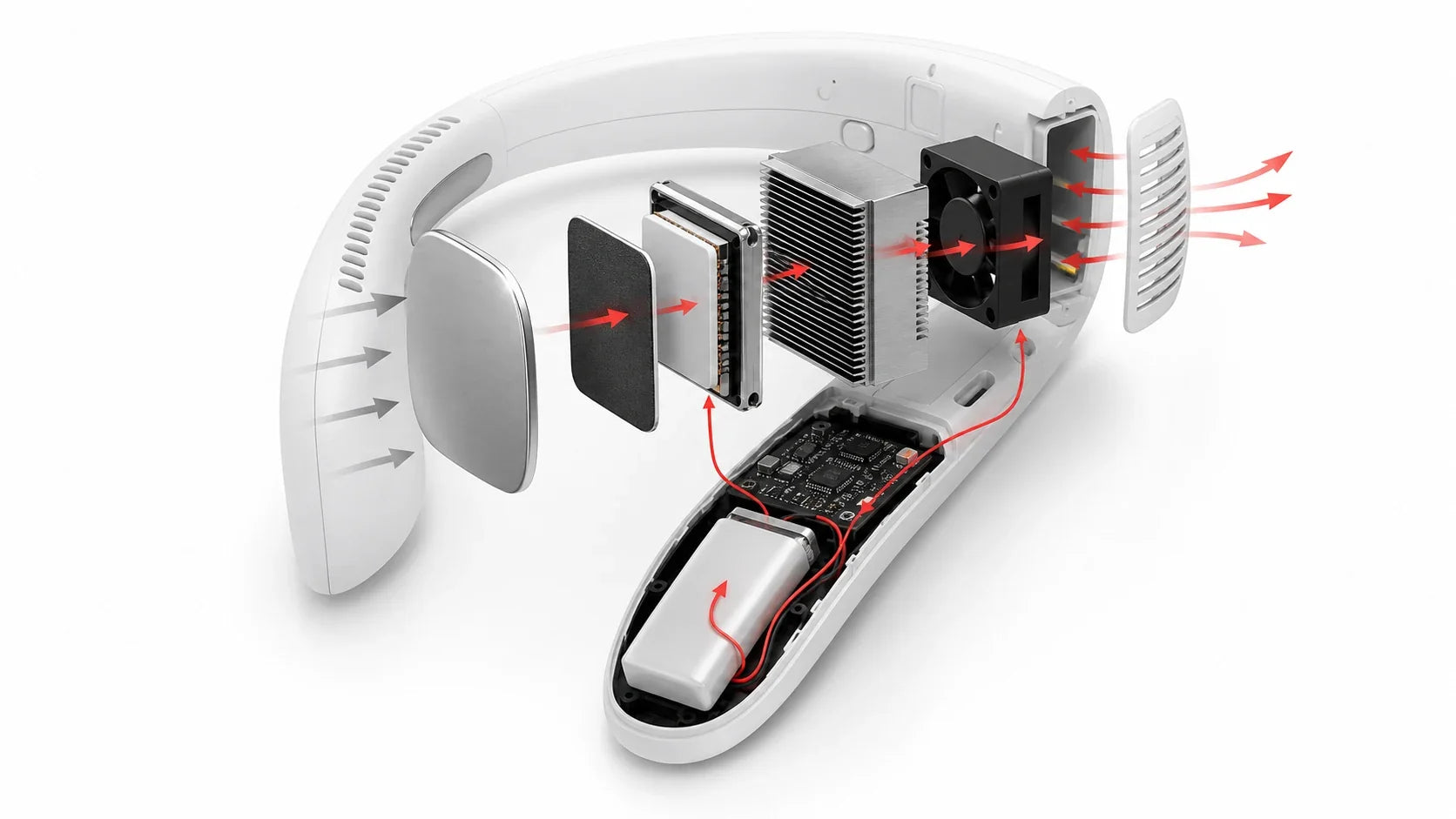
Most consumer models use thermoelectric modules. These are also called Peltier modules.
Electric current moves heat from one side of the module to the other. The skin-facing side becomes cooler. The opposite side becomes warmer.[2]
The warm side needs a heat sink and airflow. That is why active-cooling models still contain fans.
For the complete heat path, see how a Peltier cooler works in a wearable air conditioner.
The plates cool where they touch
The cooling plate affects a small contact area. It does not directly cool the arms, legs or room.
Contact is essential. A plate that floats above the neck may show a low no-load temperature while transferring little heat from the wearer.
Pressure matters too. More contact can improve heat transfer. Too much pressure can create discomfort.
Good fit balances both needs.
Heat must leave the other side
The cold plate is only half of the system.
Heat removed from the skin reaches the hot side. Electrical power adds more heat. The product must release both into the surrounding air.[2][3]
Blocked vents can reduce performance. So can poor thermal contact inside the device.
This is why the lowest advertised plate temperature is not enough. Buyers also need a loaded temperature curve and the test conditions.
The word “air conditioner” needs context
A room air conditioner cools and dehumidifies an enclosed space. It moves heat outdoors or to another area.
A portable neck air conditioner manages one person’s local comfort. It does not have room-scale coverage.
The name is useful for distinguishing active-cooling products from fan-only models. It should not imply room-AC performance.
Which one feels colder?
A neck air conditioner usually creates the stronger cold contact sensation. Its plate can become cooler than the surrounding surface.
A neck fan creates a breeze. The effect may feel broad around the jaw and neck, but it is not refrigerated air.
That does not make airflow unimportant.
Some users prefer a continuous breeze. Others find direct cold contact more noticeable. A hybrid device provides both.
Compare three different outcomes
Do not place every result under the word cooling.
-
Cooling sensation means the wearer reports feeling cooler.
-
Local skin temperature means a measured point on the neck or face becomes cooler.
-
Core body temperature means internal temperature changes under a valid research or clinical method.
A product can improve the first two without proving the third.
A 2025 randomized crossover study tested an ice-based neck cooler during exercise in a 35°C environment. More participants felt cooler, but the researchers found no significant core-temperature difference.[4]
That device was not a consumer neck air conditioner. The study does not rank either category.
It shows why a cold neck should not be treated as proof of whole-body protection.
For a deeper evidence review, read do neck fans work. It separates comfort, skin temperature and heat-safety claims.
Battery life and power use
Fan-only models usually have the advantage here.
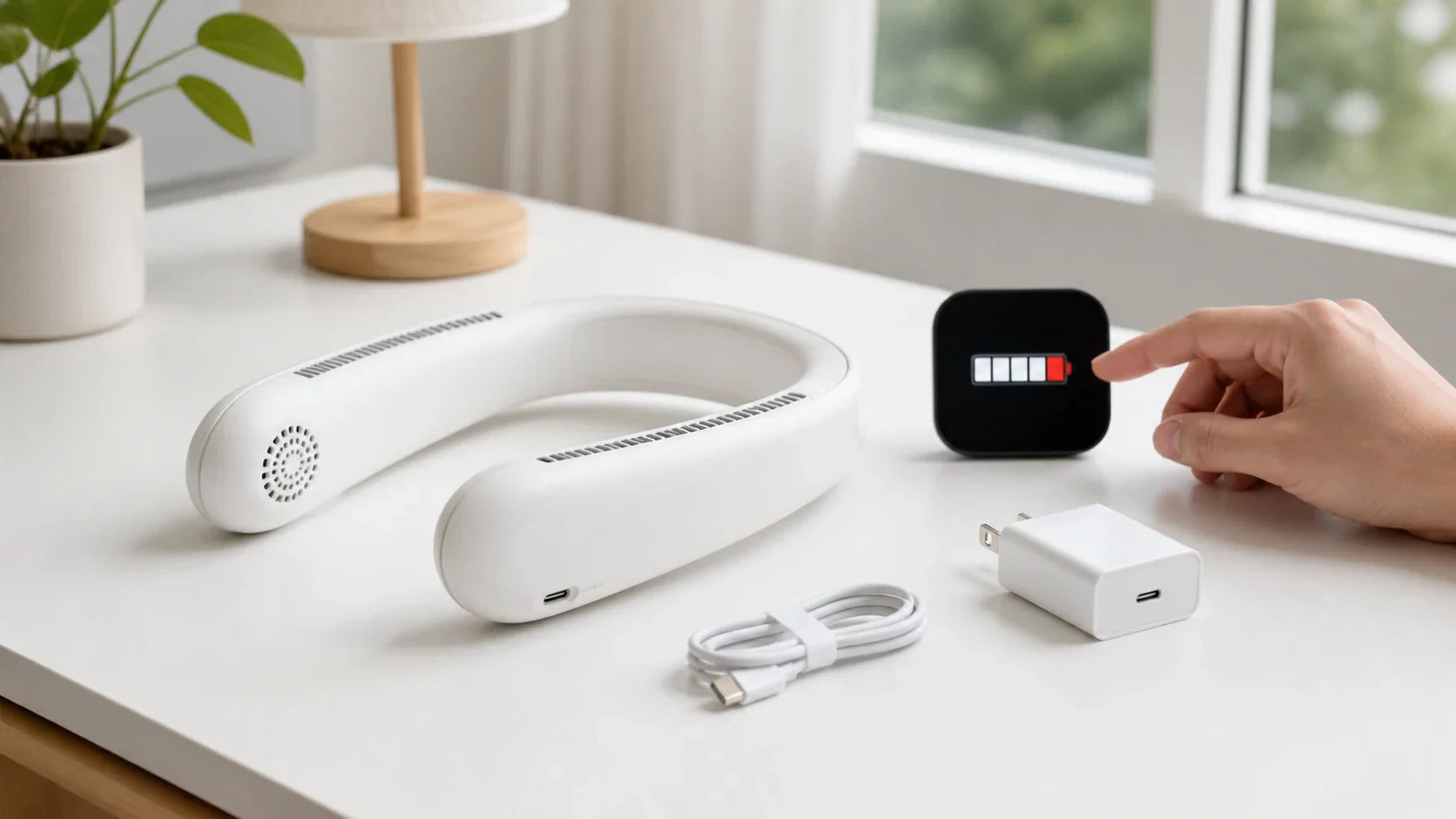
A fan needs power for the motor and controls. An active-cooling model powers the blowers, thermoelectric modules and control system.
That extra load can reduce runtime.

Compare runtime by mode
One runtime number can be misleading.
A listing may show the longest result from the lowest fan setting. The same device may run for much less time with maximum airflow and active cooling.
Look for separate figures for:
-
low, medium and high fan modes;
-
fan-only operation;
-
balanced active cooling; and
-
maximum active cooling.
Also check whether performance changes as the battery falls.
Battery capacity is not runtime
A larger battery stores more energy. It may also power a heavier or more demanding system.
Do not compare milliamp-hours alone. Voltage matters. Power draw matters too.
The useful question is simple: how long does the mode you need remain effective?
Choose a fan-only model when long continuous airflow is the priority. Choose active cooling when the stronger cold sensation is worth more frequent charging.
Weight, fit and comfort
Weight matters because the device rests on the neck.
Fan-only models can use a simpler internal system. Active-cooling models add plates, thermoelectric modules, heat sinks and extra thermal hardware.
This often makes them heavier.

Balance matters more than one number
Two products with the same weight can feel different.
A balanced device spreads the load across the shoulders and back of the neck. A front-heavy model can bounce while walking.
Fit also controls plate contact. A loose active-cooling device may lose the sensation whenever the wearer turns their head.
Before buying, check:
-
ready-to-use weight;
-
neck-opening range;
-
arm flexibility;
-
pressure at the sides and back of the neck;
-
stability while walking; and
-
compatibility with hair, glasses and collars.
If possible, judge comfort after 20 minutes. A quick try-on can hide pressure points.
Noise and airflow
Both categories place small motors close to the ears.
This makes sound quality important. A high-pitched tone can be distracting even when a room measurement looks acceptable.
Fan-only models create noise from their airflow system. Active-cooling models may also need airflow across the hot-side heat sink.
More hardware does not automatically mean more noise. Fan size, speed, vent shape and control logic all matter.
Use the product in the situation that matters most.
For desk work, test the lowest useful mode. For commuting, check whether you can hear announcements and traffic. For calls, confirm that the microphone does not pick up the airflow.
Price and maintenance
A basic neck fan is usually the lower-cost option. Its mechanism is simpler.
A neck air conditioner includes more parts. It may add temperature sensors, thermal controls, larger heat sinks and a higher-power battery system.
Those parts can raise the price.
Price should follow the use case. Do not pay for active plates if you only want a breeze. Do not buy a fan-only model if a strong cold contact sensation is the main goal.
Cleaning needs are similar
Both types collect sweat, sunscreen, skin oil and dust.
Wipe skin-contact surfaces as directed. Keep the air intakes clear. Do not push tools into the vents.
Active-cooling plates may also develop condensation in humid conditions. Follow the moisture and storage instructions.
Stop using any device that has a swollen battery, burning smell, liquid entry or unusual heat. Do not open the battery or cooling module yourself.
Which one should you choose?
Use the table below as a starting point.

| If this sounds like you | Start with | Reason |
|---|---|---|
| You want the lightest practical option | Neck fan | The simpler system is usually lighter. |
| You need long airflow on a commute | Neck fan | Fan-only modes usually use less power. |
| You dislike direct cold contact | Neck fan | Cooling comes from moving air, not a cold plate. |
| You want a clear cold sensation | Neck air conditioner | Thermoelectric plates cool the contact area. |
| You often use the device in humid weather | Neck air conditioner | Plate cooling is less dependent on sweat evaporation. |
| You want both breeze and contact cooling | Hybrid neck air conditioner | It combines the two mechanisms. |
| You are sensitive to neck pressure | Try both in person | Fit and load distribution matter more than category labels. |
| You need protection during hazardous heat | Neither as a standalone control | Start with an environmental or workplace heat plan. |
The best choice is not the product with the longest feature list. It is the one whose mechanism matches your expectation.
If you want a breeze, prioritize vent position, weight, noise and runtime.
If you want active contact cooling, prioritize plate coverage, fit, loaded temperature, heat rejection and mode-specific runtime.
Once you know the category, use our best neck fan guide to compare current options.
Frequently asked questions
Is a neck air conditioner colder than a neck fan?
It usually creates a colder contact point because thermoelectric plates can cool below the surrounding surface. A fan-only model moves ambient air and supports evaporation. The total experience still depends on fit, airflow and weather.
Do cooling plates use more battery?
Usually yes. The device must power the thermoelectric modules and release heat from their hot side. Compare runtime in active-cooling mode, not only the longest advertised fan-only result.
Can both types be bladeless?
Both can hide the moving impellers inside an enclosed housing. “Bladeless” usually means there is no exposed propeller. It does not tell you whether the product has cooling plates.
Does a neck air conditioner blow refrigerated air?
Most consumer models use ambient air at their outlets. Their thermoelectric system cools the contact plates. Check measured outlet-air data before accepting any refrigerated-air claim.
Is a portable neck air conditioner worth the higher price?
It can be worth it when cold contact is your main goal. A neck fan is often better value when you mainly want airflow, lighter weight and longer runtime.
Which type is better for high humidity?
Active plates can provide a clearer cold sensation because they do not rely on sweat evaporation in the same way. The device still needs good fit and hot-side airflow.
Can either product prevent heat stroke?
Do not rely on a consumer neck device to prevent or treat heat illness. NIOSH treats personal cooling as one possible part of a wider heat-control plan, not a replacement for engineering controls, hydration, acclimatization, work-rest schedules or emergency procedures.[5][6]
The bottom line
A neck fan moves surrounding air. It is usually lighter, simpler and better suited to long airflow sessions.
A neck air conditioner adds thermoelectric plates. It can create a stronger cold contact sensation, but it usually adds weight and power demand.
Choose the mechanism first. Then compare fit, noise, battery life and maintenance.
Next step: Review the best neck fans and neck air conditioners after deciding whether you want airflow, active contact cooling or both.
Sources
[2] Ferrotec, “Introduction to Thermoelectric Cooling,” Thermoelectric Technical Reference Guide.
[3] Ferrotec, “Heat Sink Considerations,” Thermoelectric Technical Reference Guide.
[5] NIOSH, “PPE Heat Burden,” updated March 3, 2026.
[6] NIOSH, “Workplace Recommendations” for heat stress, updated March 3, 2026.