









The uvula is the small, teardrop-shaped piece of tissue that hangs at the back of your throat. It helps guide food and liquid during swallowing, supports normal speech sounds, moisturizes the throat, and plays a small part in your gag reflex. The uvula is important but not essential: many people live normally after having it removed or surgically reduced.
The uvula’s main job is to help keep food, liquid, and air moving in the right direction. It is not a useless leftover, but it is also not the main structure that prevents choking.
Where It Sits and Why That Location Matters
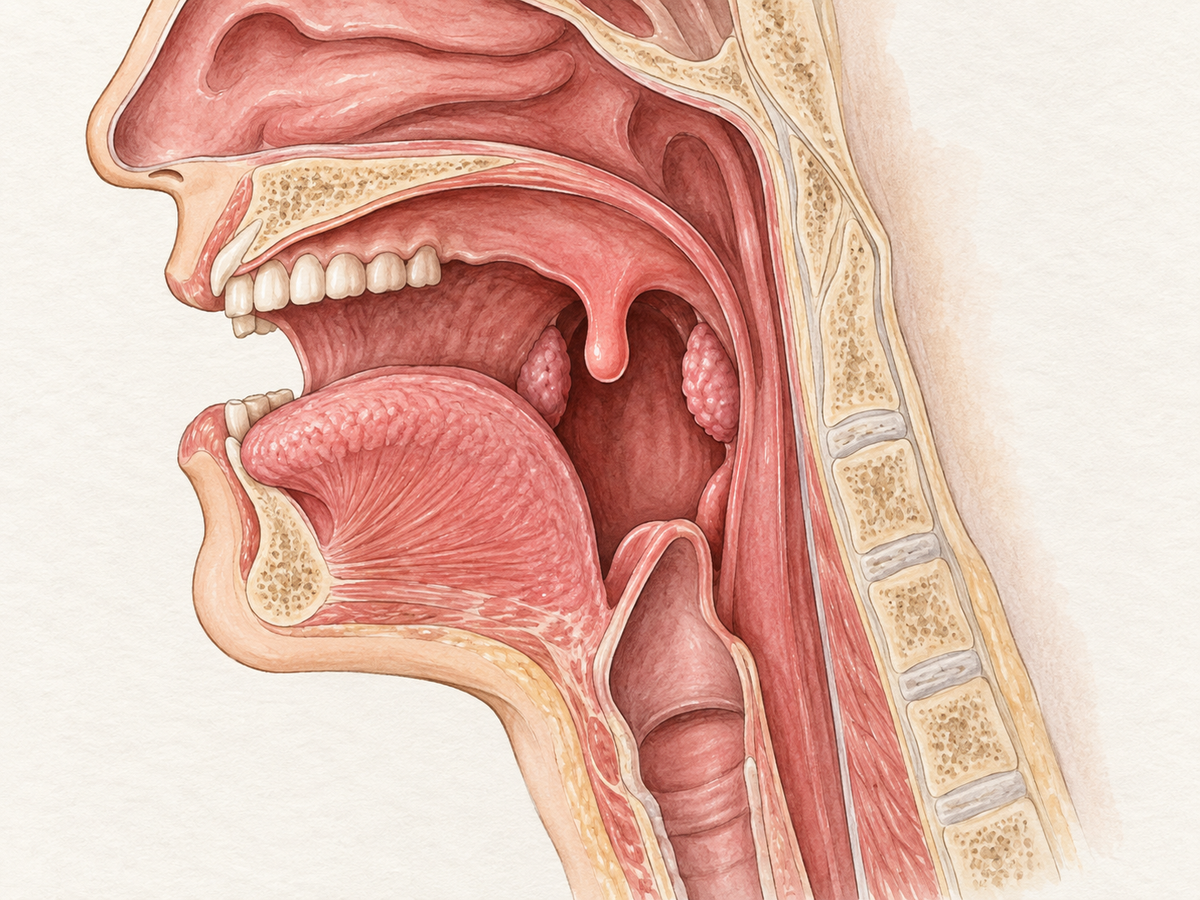
The uvula is the fleshy, teardrop-shaped dangly tissue you see at the back of the throat. It hangs from the soft palate, which is the soft back part of the roof of the mouth. You can feel the front of the roof of your mouth with your tongue, but the uvula is harder to see without a mirror and good light.
The uvula sits in the oropharynx, the middle part of the throat behind the mouth. It is positioned between the palatine tonsils, which most people simply call the tonsils. This central location is useful. Because the uvula hangs in the middle of the throat, it can move with the soft palate when you swallow or talk.
The broader area is the pharynx, or throat. Think of the uvula as one small but well-placed part of a larger team that manages breathing, eating, and speaking.
Swallowing: Guiding Food and Liquid Down
During swallowing, the soft palate and uvula lift together. This movement helps seal the nasopharynx, the space behind the nose above the throat. That seal keeps food and liquid from going up into your nose.
The food or liquid that is ready to swallow is called a bolus. As the bolus moves toward the throat, the uvula and soft palate help direct it downward. But a common idea is wrong: the uvula is not the main flap that protects your airway.
The epiglottis is the flap that protects the airway. It covers the larynx, or voice box and airway entrance, when you swallow. The uvula assists with guiding the bolus, but it is not the main structure that prevents choking.
Why the correction matters: understanding that the uvula is a helper, not the main swallowing flap, helps explain why losing it does not usually cause major swallowing problems.
Speech and Sound Shaping
The uvula also supports clear speech. It works with the soft palate to create velopharyngeal closure, the seal between the mouth and the nasal passage. This seal lets most speech sounds resonate through the mouth rather than the nose.
Without that seal, too much air can escape through the nose. That can create a nasal quality in the voice. The uvula’s role is to help the soft palate make a good seal for oral resonance, or the normal mouth-based sound quality of speech.
Some languages use sounds shaped partly by the uvula. In English, the uvula has a smaller role in speech. Many people worry about sounding different if the uvula is removed. In most cases, speech changes are minor or temporary. The soft palate and other throat tissues usually compensate.
The uvula is not the main driver of speech articulation, or the shaping of speech sounds. That is mostly the job of the tongue, lips, and palate working together.
The Gag Reflex and Throat Protection
The uvula is touch-sensitive. When something unexpected touches the back of the throat, it can trigger the gag reflex, the throat-clearing or retching reflex.
The gag reflex involves more than the uvula. The posterior pharyngeal wall, or the back wall of the throat, is also very sensitive. The uvula is one trigger point, but it is not the only one.
This reflex is protective. A foreign object, something unexpected in the throat, can set it off. That can help keep the object from moving deeper toward the airway, the breathing passage, or the digestive tract, the food and swallow passage.
Gag reflexes vary widely from person to person. Some people gag from a tongue depressor touching the uvula. Others need much more stimulation. The uvula is one part of a larger defense system, not a standalone gatekeeper.
Does It Help With Immunity or Saliva?
The uvula contains mucous glands, or mucus-producing glands, and connective tissue, the supporting tissue. These glands may add a small amount of moisture to the throat.
Some people ask whether the uvula is an immune organ like the tonsils. The answer is no. The tonsils and adenoids are much more involved in immune responses because they contain more immune tissue. The uvula is sometimes grouped with throat tissues, but it is not a major immune organ.
Still, the uvula is not a useless leftover. Its mucus glands may contribute slightly to saliva production and throat lubrication, or moistening of the throat. That moisture helps keep swallowing comfortable. Research has described the uvula as producing thin saliva and helping keep the throat moist and lubricated, according to a literature review on the function of the uvula.
What Happens If It Swells or Is Removed
A swollen uvula is one of the most common reasons the uvula gets attention. Uvular swelling can happen after dehydration, alcohol use, snoring, an infection, an allergic reaction, or an injury. It can feel odd, trigger the gag reflex, or make the throat feel full.
Some people have an uvula elongation, meaning the uvula is stretched or longer than usual. A long uvula can vibrate during sleep and may contribute to snoring. It may also catch on the back of the throat and trigger the gag reflex.
Snoring and sleep apnea are common reasons people talk with a doctor about the uvula. Sleep apnea is a condition where breathing pauses repeatedly during sleep. One surgery for sleep apnea is called uvulopalatopharyngoplasty, or UPPP. This surgery can remove or reshape the uvula and nearby tissue.
However, surgery is not a simple fix for sleep apnea on its own. Clinical guidance notes that UPPP as a single procedure does not reliably normalize the apnea-hypopnea index in moderate to severe sleep apnea, and positive airway pressure therapy is often preferred first, according to practice parameters on surgical modifications for obstructive sleep apnea.
After uvula removal, many people live normally. Some notice temporary swallowing changes or speech changes while the throat heals. Most adjust well. A dry throat can occur after surgery because the uvula no longer adds its small amount of moisture.
When to Pay Attention to Uvula Symptoms
Most uvula changes are minor and settle on their own. But some symptoms need urgent care.
Get immediate medical help if you have:
- Sudden severe uvular swelling, especially if it came on quickly
- Trouble breathing
- Trouble swallowing
- Inability to swallow saliva, which may look like drooling
These can be signs of a serious allergic reaction or airway blockage.
Call your doctor or dentist for a non-urgent visit if you have:
- Persistent one-sided swelling of the uvula or throat
- Ongoing soreness or irritation that does not improve
- Snoring concerns that affect sleep or breathing
- A long uvula that regularly triggers the gag reflex or feels uncomfortable
Your Uvula: A Helper, Not a Hero
The uvula sits in the middle of the throat doing quiet, helper-level tasks. It supports swallowing, speech, throat moisture, and a protective reflex. It is not the main swallowing flap, not a major immune organ, and not essential for life.
Understanding its normal role helps you recognize when a change is minor and when it needs attention. For most people, the uvula works behind the scenes. If it swells, changes, or needs removal, the rest of the throat usually adapts well.
 Best Overall
 Best Value
 Best for Sensitive Teeth
This article has been reviewed by an oral health professional for accuracy. It is intended to provide general educational information and should not be used as a substitute for personalized medical advice, diagnosis, or treatment. If you have questions or concerns about your oral health, please consult a dentist, physician, or other qualified healthcare provider.